


Please Leave Us A Message
Privacy statement: Your privacy is very important to Us. Our company promises not to disclose your personal information to any external company with out your explicit permission.
 Shanghai Healpoint Industrial Development Co. LTD
Unit price is the wrong number to compare; cost per procedure is the right one. A finance committee reviewing a Bipolar Coagulation Forceps order should convert every quote into an annual per-case figure before deciding between single-use and reprocessable lines. Published market reports place the reusable advantage above roughly 3,000 procedures a year, but that threshold is an illustrative model, not a rule. Healpoint supplies the worksheet structure and asks buyers to replace every figure with their own tender quotes.
A usable worksheet compares total annual spend, not the sticker on a single box. Split the calculation into two columns and keep the assumptions identical on both sides. The single-use column is simple: quoted price per item multiplied by annual procedure volume, with no reprocessing overhead. The reusable column has three parts: the upfront instrument price amortised over its realistic cycle count, the per-case cost of cleaning and sterilisation, and a reserve for tips, insulation failure and eventual replacement. Published market reports and 2026 hospital award notices give broad price bands for both routes, but treat each band as an illustrative model and verify it against the vendor's current file.
A worked example, purely illustrative, helps frame the maths. Published market reports describe a reprocessable pencil in the range of 45 to 65 per unit with replacement tips at 8 to 15, amortised across 200 to 400 cycles to roughly 0.02 to 0.08 per case once sterilisation labour is included, against a single-use item quoted at 22 to 38 with no reprocessing. Other sources put a reprocessable handle at 300 to 600 over three to five years and a single-use item at 30 to 100. These figures are inputs for the worksheet, not prices and not conclusions; replace them with your own awarded rates before the model means anything.
| Annual procedures | Single-use annual spend (illustrative) | Reusable annual spend (illustrative) | Lower-cost option in this model |
| 500 | 11,000 to 19,000 | 600 to 1,600 plus reprocessing | Single-use |
| 1,500 | 33,000 to 57,000 | 1,200 to 2,400 plus reprocessing | Single-use |
| 3,000 | 66,000 to 114,000 | 2,400 to 4,800 plus reprocessing | Near break-even |
| 5,000 | 110,000 to 190,000 | 4,000 to 8,000 plus reprocessing | Reusable |
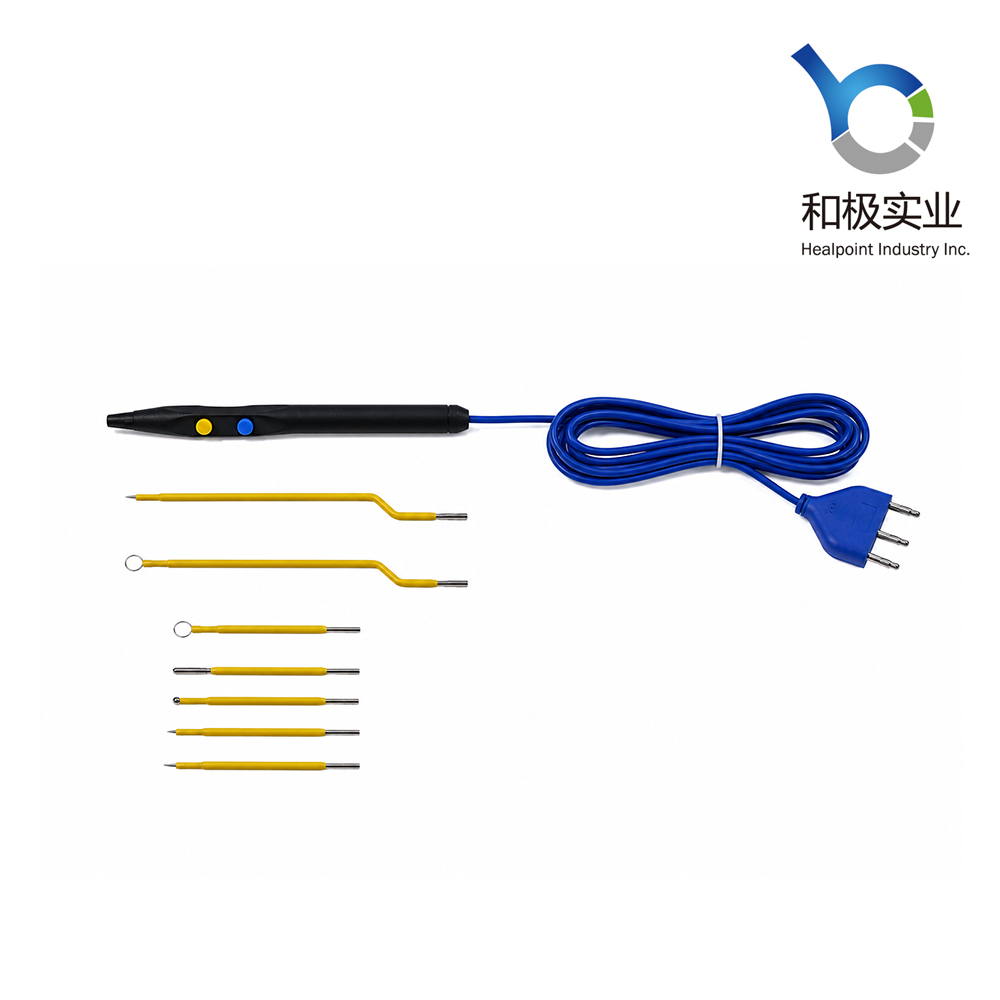
When a Radiofrequency Monopolar Surgical Electrode is quoted as part of a disposable line, separate the pencil, the tip and any cable from the per-case figure so the two columns stay comparable. Mixing a bundled disposable quote with a bare reusable handle is the most common way a worksheet quietly favours the wrong option.
✅ Inputs to fill from your own data:
Ask each supplier for the price per case and the reprocessing count in the same units, then document who supplied each input. Healpoint can share a blank worksheet that lists every field, so the finance committee and the OR work from one set of assumptions rather than two competing spreadsheets.
✅ Bottom line: Put both options on one annual per-case basis; a cheap box can still be the expensive year.
The break-even is a range that moves with your hidden costs, not a single magic number. Published market reports suggest a low-volume site near 500 procedures a year often favours single-use, while a high-volume site above roughly 3,000 procedures can favour reprocessing; some analyses even report five-year savings above 15,000 at low volume and a return above 200 percent. Every one of those numbers is an illustrative model drawn from published market reports and hospital award notices, not a forecast for your ASC. Replace them with your own awarded rates and verify them against the vendor's current file.
What flips the answer is rarely the electrode itself. Reprocessing is bounded by a finite cycle count, often 200 to 400 before insulation fails, and by the sterilisation capacity of your CSSD. Add the labour to clean, inspect, pack and track each item, plus waste handling and the infection-control rules that mandate single-use in some cases. On the other side, add downtime. One published operations analysis prices an idle OR at more than 3,000 per hour and annual generator maintenance at 800 to 1,200; a delayed case caused by a missing reprocessed instrument can erase a per-case saving in a single afternoon. Reimbursement caps, such as a procedure price ceiling near 80 in some DRG systems, and centralised award prices as low as 16 per item in 2026 notices, also compress the room for a premium option.
When a value analysis committee reviews Surgical Consumables as a whole portfolio, the break-even should be computed per SKU family rather than applied as one blanket threshold. Published market reports also describe wholesale pricing tiers that change the disposable unit price, so model at least two price bands before you commit. Healpoint recommends stress-testing the result at plus and minus 20 percent on volume, because a threshold that flips on a small forecast error is not a decision-grade number.
Buyers working with Shanghai Healpoint Industrial Development Co., Ltd. can request an itemised cost grid that separates the instrument, the tip, the cable and the reprocessing overhead, so each line can be challenged independently. Healpoint keeps the conclusion conditional on your own inputs; the worksheet is a framework for a defensible decision, not a claim about what any site should buy.
✅ Bottom line: Treat 3,000 as a starting hypothesis; reprocessing labour, downtime and CSSD limits decide the real break-even.
Q: Is the 3,000-procedure threshold a fixed rule? A: No. It is an illustrative model from published market reports; replace every figure with your own awarded prices and local reprocessing costs before deciding.
Q: We buy in bulk but run a small CSSD; does that change the answer? A: Yes. Limited sterilisation capacity and insulation failure after 200 to 400 cycles can push the break-even upward, so price the reprocessing labour honestly.
Q: Can Healpoint supply the worksheet template? A: Yes. We can share a verifiable cost-per-procedure grid to send to any distributor, so the single-use and reusable columns are built from the same assumptions.
Send Healpoint your annual procedure count, reprocessing capacity and current price bands, and we will return a custom TCO grid with single-use and reusable columns on the same assumptions. Replace every illustrative figure with your own tender quotes and the vendor's current file before you commit, since the model is illustrative only. A shared worksheet keeps the finance committee and the OR on the same numbers.
Mobile: +86 15021310098
Email: ysy1107@hotmail.com
Website: www.healpointshanghai.com
Email to this supplier
Privacy statement: Your privacy is very important to Us. Our company promises not to disclose your personal information to any external company with out your explicit permission.
Fill in more information so that we can get in touch with you faster
Privacy statement: Your privacy is very important to Us. Our company promises not to disclose your personal information to any external company with out your explicit permission.